
The Silent Killer of Tech:
Why is Electronics Dying en Masse on the Frontline?
When people talk about power supply in a war zone, most imagine total blackouts. However, the reality on the Ukrainian frontline is often much more insidious. While destroyed and provisionally repaired infrastructure often still supplies some electricity, its quality is catastrophic.
Explained Simply
Imagine the electrical grid as a water pipeline. The voltage in the grid is like water pressure. Under normal conditions, water flows smoothly and at a constant pressure. But in a damaged frontline grid, it is as if the pipes are full of holes and the pumps are broken—the pressure spikes dangerously for a moment, then drops to a minimum, and the pipes unpredictably “sputter”. Standard electronics (adapters, chargers) are like a very delicate and sensitive irrigation system. If you force such wildly fluctuating pressure into it, it simply bursts.
Extreme voltage fluctuations, deep undervoltage, and constant grid interference pose a lethal threat to sensitive electronics. Standard adapters for reconnaissance drones (UAVs), radios, Starlink terminals, and laptops are not built for such “torture”. The results are burnt-out chargers and destroyed equipment. In field conditions, this does not just mean financial loss; it is a massive logistical nightmare. If you have no way to charge your laptop or drone batteries, your unit is blind.
FUP as the absolute barrier between chaos and your tech
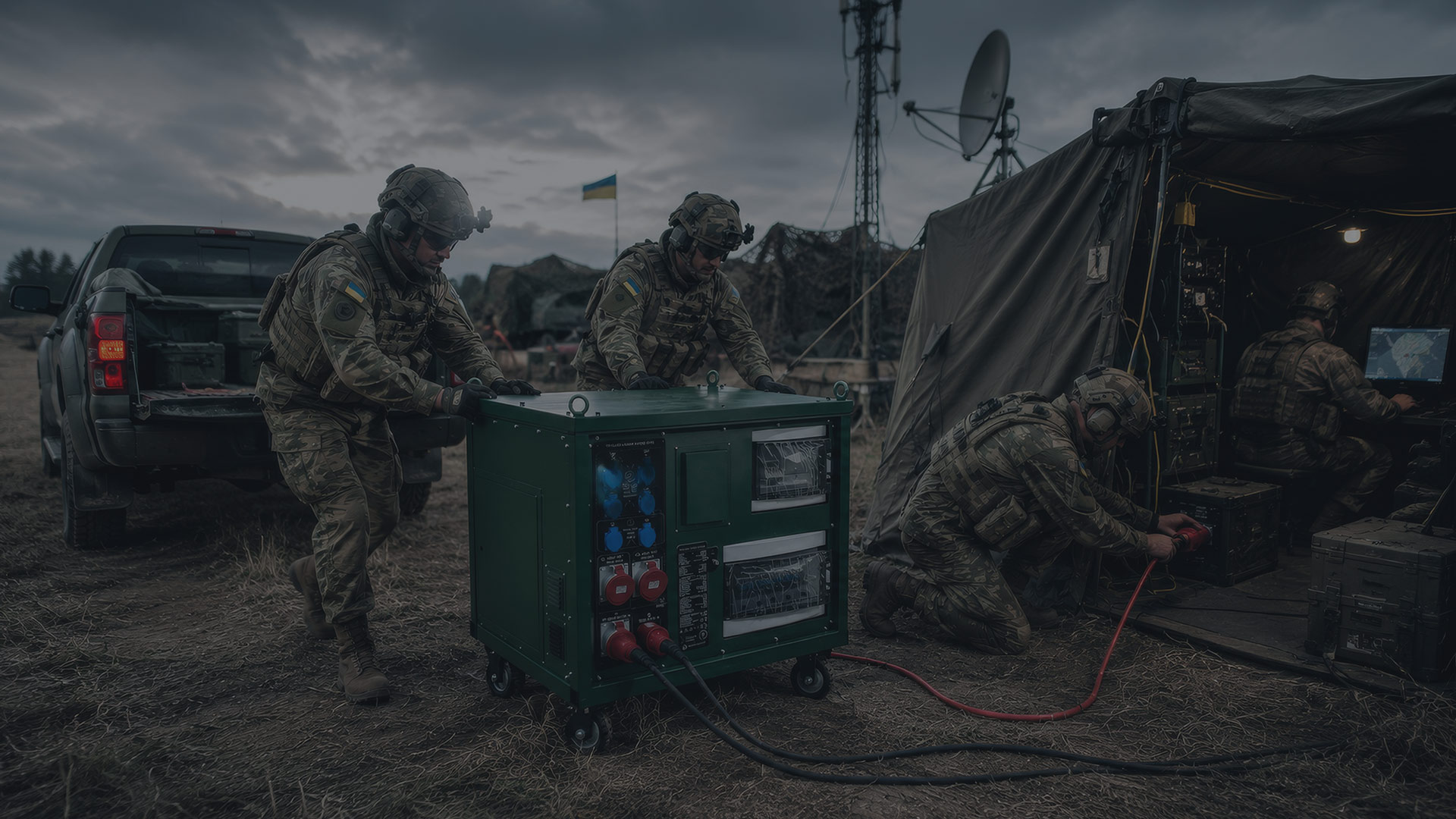
This is exactly where our Mobile Hybrid Power Hub (FUP). proves to be absolutely crucial. On the frontline, it does not just act as a “dumb” oversized battery or generator; it serves as an uncompromising guardian and a physical barrier between the ruined grid and critical infrastructure.
Returning to our water pipeline analogy: the FUP acts as a massive reservoir with a smart safety valve. The moment the external pressure starts fluctuating dangerously, the system does not try to somehow tame this dirty, sputtering water. It simply shuts off the main supply instantly and begins seamlessly feeding your equipment with clean energy from its own reserves.
How FUP protects electronics
– Lightning-fast monitoring: FUP constantly monitors the quality of the incoming grid.
– Instant disconnection: If the voltage drops below a tolerable limit or begins to fluctuate wildly, the FUP does not attempt to accept this “dirty” energy. It makes the safest possible decision—it instantly disconnects the unstable input grid.
– Seamless transition to battery: In that exact fraction of a second (with a reaction time of under 10 milliseconds), a massive integrated battery takes over the entire load.
– Clean energy: The inverter begins generating its own perfectly clean and stable sine wave (exactly 230V/400V) from the battery.
Once the external grid stabilises, the FUP safely reconnects to it and recharges its batteries. Your electronics will never even notice that the grid outside just collapsed.
What does this mean in practice? Feedback direct from the battlefield:
Deploying the FUP provides units with three crucial advantages that can determine the success of an operation:
> The end of dead adapters: The issue of writing off chargers en masse has disappeared. Because the FUP cuts off a bad grid before it can cause harm, the electronics only ever receive the voltage they were designed for.
> Logistical relief: Eliminating the unnecessary loss of adapters means supply lines can focus on ammunition and medical supplies, rather than constantly sourcing new chargers for drones and computers.
> Command Continuity (C2): Headquarters and field hospitals run without outages and without system reboots. Even if someone outside turns on heavy machinery on the same phase and the grid collapses, the lights inside the command tent do not even flicker. Systems continue running purely on battery power.
The FUP proves that modern field energy is not just about “having power,” but above all about having reliable and safe power that you can depend on even in the harshest conditions. We thank the FORT group for their feedback.
Physics corner to conclude
- Most modern electronics use Switched-Mode Power Supplies (SMPS), which operate on the principle of constant power.
- Physics is unforgiving; the rule is that:
- f we need a constant power P,, and the input voltage U drops (undervoltage in the grid), the power supply must inevitably increase the drawn current I.
- This increased current causes an exponential rise in heat losses on the power components of the supply (MOSFET transistors, rectifier diodes, coils), because power loss grows with the square of the current: (). If the power supply lacks sufficiently rated or fast enough undervoltage protection (Brownout protection), the components will exceed their maximum operating temperatures, leading to thermal breakdown and destruction.
- If the grid voltage drops from 230 V to 115 V (i.e., by half), the current must double. But because heat increases with the square of the current (22=4), the components inside the power supply suddenly generate four times as much heat. No standard laptop adapter or drone charger is structurally prepared for this. That is why, without the protection provided by the FUP, these power supplies literally catch fire on the frontline.
- Example: A standard gaming or workstation laptop, frequently used on the frontline for command and control (C2) or drone operation (assuming a 150W draw).
- At an ideal 230 V:
The adapter is lukewarm and works without issues. - At a drop to 170 V:
The adapter starts becoming uncomfortably hot to the touch. - At a critical drop to 120 V:
- At an ideal 230 V:
- The plastic casing of the adapter can become literally scorching hot. Most standard commercial adapters will collapse under this prolonged load without active cooling.